

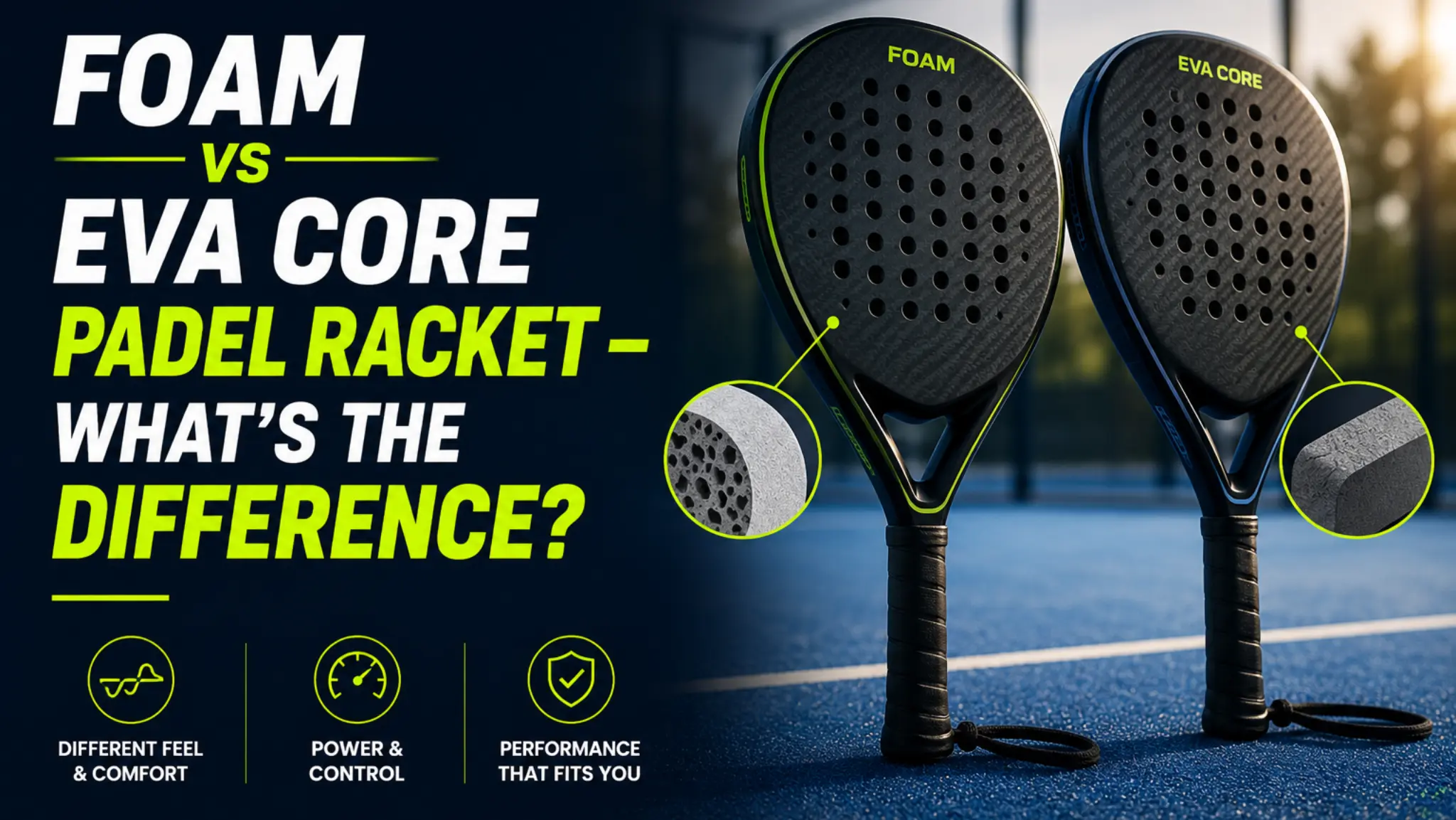
Foam vs EVA Core Padel Racket – What’s the Difference?

Most players choose a padel racket based on brand, color, and shape. The one decision that actually determines how the racket feels, performs, and lasts goes unread: the core material. The foam inside your racket head is the engine behind every shot. It controls power transfer, ball dwell time, vibration absorption, and structural durability. Get it wrong and you are fighting your own equipment every time you step on court.
There are two core materials used across virtually every padel racket: EVA foam (Ethylene Vinyl Acetate) and polyethylene foam (PE foam), commonly labelled simply as FOAM on racket spec sheets. Both are foam. But they behave in completely different ways under impact, and those differences have direct consequences for your game.
This guide explains exactly what each core does, how it shapes racket performance, and critically for players in Dubai, Abu Dhabi, and across the UAE, how the regional climate affects each material.
Quick Answer: EVA core gives you firmer feel, explosive power, and better durability. Best for intermediate to advanced players. Polyethylene FOAM core gives you softer feel, larger sweet spot, and better vibration absorption. Best for beginners, players with arm injuries, or anyone prioritising comfort over power.
What Is the Core of a Padel Racket?
The core is the internal foam filling sealed inside the racket head, positioned between the outer face sheets of carbon fibre or fibreglass. It is never visible, yet it is the single most influential component in how a racket plays.
When the ball strikes the face of your racket, it compresses into that foam for a split second before rebounding. During that brief window of contact called dwell time, everything happens: power transfer, ball direction, spin generation, vibration, and feedback to your hand and arm. The density and composition of the core controls all of it.
Padel racket manufacturers tune core foam to achieve specific performance targets. A harder, denser foam produces a crisper, more explosive response. A softer, lower-density foam absorbs more impact energy, cushions vibration, and gives the ball more time on the face, which means greater forgiveness and spin potential.
The two base materials used across leading padel brands including Adidas, NOX, Bullpadel, Head, and Babolat are EVA and polyethylene. Each starts from a different chemical foundation, which is why they perform so differently even at similar thicknesses.
EVA Foam Core: Power and Precision
EVA (Ethylene Vinyl Acetate) is a thermoplastic polymer that is high-density, firm, and structurally compact. Its closed-cell structure gives it resilience and natural elasticity that returns energy efficiently on impact.
When the ball hits an EVA core, the foam compresses minimally. Most of the kinetic energy transfers directly back into the ball, producing a sharp, explosive rebound. EVA rackets feel powerful because the core acts like a compressed spring, returning force rather than absorbing it.
EVA Core Performance:
- Power output: High energy return per strike. Hard smashes transfer force efficiently. Players who generate their own pace extract maximum benefit.
- Precision and control: Firmer response gives cleaner, drier ball feedback. You feel exactly where on the face contact was made, which is vital for technical shot placement.
- Sweet spot: Smaller and more centralised. Rewards consistent, clean technique. Off-centre hits feel noticeably harsher.
- Vibration: EVA absorbs less energy, meaning more vibration travels through the frame into your hand and wrist. Players with elbow or wrist conditions should factor this in.
- Durability: High density resists permanent compression over time. The core retains its playing characteristics through heavy use far longer than polyethylene foam.
EVA Variants: Not All EVA Is the Same
Manufacturers tune EVA to different densities. You will see names like HR3 Black EVA used by NOX on the AT10 Genius series, which is Alejandro Galán’s World Padel Tour racket, MLD Black EVA, and EVA Soft Energy used by Adidas on spec sheets. These are all EVA but behave differently based on density calibration. Soft EVA delivers more forgiveness with slightly reduced power. Hard EVA maximises explosive response for advanced players.
Best For EVA Core: Intermediate and advanced players with consistent technique who generate their own pace and prioritise precision and long-term racket durability.
Polyethylene (FOAM) Core: Comfort and Forgiveness
Polyethylene (PE) foam, labelled FOAM on spec sheets, is a lower-density material with an open-cell, porous structure. It is significantly softer than EVA and responds to impact in a fundamentally different way.
When the ball hits a PE foam core, it sinks deeper into the face before rebounding. This longer dwell time allows the player more influence over ball direction, angle, and spin. The core absorbs a portion of the impact energy, cushioning the response and dramatically reducing vibration transmitted to the hand and arm.
Polyethylene Core Performance:
- Ball output and rebound: Lively bounce with a spring effect. The ball leaves the face with good pace even on softer, less aggressive shots.
- Forgiveness: Large sweet spot. Mishits do not feel harsh or punishing, which is critical for developing players still building technique consistency.
- Spin generation: Longer dwell time gives the face more opportunity to grip and rotate the ball before release. Tactical players who rely on spin and placement benefit directly.
- Vibration absorption: The porous structure absorbs shock effectively. The preferred core for players managing tennis elbow, wrist pain, or arm fatigue.
- Durability: Softer foam compresses more with each impact and fatigues faster. PE foam rackets generally require replacement sooner than EVA equivalents.
Which Brands Use Polyethylene Foam?
Head is the most prominent brand using polyethylene foam, featured across their Gravity series, which is one of the most arm-friendly racket lines in the market. PE foam is less widespread than EVA overall but remains the default choice for beginner-oriented rackets and models targeting comfort-first performance.
Best For FOAM Core: Beginners learning padel technique, players returning from arm or elbow injuries, and anyone who prioritises comfort and a large sweet spot over maximum power output.
EVA vs FOAM Core: Head-to-Head Comparison
| Property | EVA Foam Core | Polyethylene (FOAM) Core |
| Material | Ethylene Vinyl Acetate | Polyethylene (PE) |
| Density | High, firm and compact | Low, soft and porous |
| Feel on Impact | Crisp, explosive, precise | Soft, springy, forgiving |
| Power Output | Very high, efficient energy transfer | High, lively rebound effect |
| Ball Control | Excellent, drier tighter response | Good, more ball dwell time |
| Vibration | Higher, transmitted to arm | Lower, core absorbs shock |
| Sweet Spot | Medium, rewards clean technique | Large, forgives mishits |
| Durability | Longer lifespan | Shorter, compresses faster |
| Arm Friendliness | Less forgiving on elbow and wrist | Ideal for elbow and wrist issues |
| Best For | Intermediate to advanced players | Beginners to intermediate players |
| UAE Heat Impact | More resistant at high density | Softens faster in extreme heat |
How UAE Heat Affects Your Racket Core
This is the section most international padel guides skip and the most relevant for players in Dubai, Abu Dhabi, and Sharjah.
Both core materials are thermally sensitive. When temperature rises, foam molecules expand and lose density. The result is what players call the dead racket effect, where a frame that felt crisp in March starts feeling soft and unpredictable by July.
EVA Core in UAE Heat
High-density EVA is structurally more resistant to heat-related softening. In summer, a firm EVA core maintains its power characteristics better than a soft foam equivalent. However, inside a parked car in Dubai from May to September where internal temperatures routinely exceed 70°C, even EVA suffers EVA memory loss. The foam’s natural recovery rate after impact slows, and the racket starts feeling progressively dead through a session. Core damage from sustained heat exposure is permanent.
Polyethylene (FOAM) Core in UAE Heat
PE foam is less dense and more affected by ambient heat. In UAE summer conditions, FOAM core rackets soften faster and lose power output sooner. On outdoor courts, ball pressure increases with heat, making the ball faster and bouncier, which compounds handling issues from an already-softened core. For UAE players using FOAM core rackets in summer, a thermal padel bag is not optional. It is essential equipment.
UAE Recommendation: For year-round play across the Emirates, particularly through summer months on indoor courts, high-density EVA core rackets are the more durable and consistent choice. If you prefer FOAM core for comfort, always store in a thermal bag and never leave your racket in a parked car during summer.
Hybrid Cores: Best of Both Materials
Leading brands now engineer hybrid core constructions that combine layers of EVA and PE foam, or different densities of EVA within the same racket, to balance power, control, and forgiveness. Bullpadel with the Vertex 04 Hybrid, Adidas, NOX, and Munich all use hybrid core architecture in their 2025 and 2026 racket lines.
Hybrid core rackets are ideal for intermediate players who want versatility rather than a single extreme characteristic. If you are developed enough to appreciate EVA’s control but still building consistency, a hybrid core is the logical starting point before committing to a pure EVA construction.
Which Core Should You Choose?
Choose EVA Core if:
- You have 6 to 12 months or more of padel experience with consistent technique
- You generate your own power and want the racket to return it efficiently
- You prioritise control, shot precision, and long racket lifespan
- You play competitively across multiple sessions per week
- You play primarily on indoor air-conditioned courts
Choose Polyethylene (FOAM) Core if:
- You are new to padel and still developing technique
- You have a history of tennis elbow, wrist pain, or shoulder strain
- You prefer comfort and forgiveness over maximum explosive power
- You play casually without a competitive focus
- You rely on spin, angles, and placement over pace
Choose Hybrid Core if:
- You are at intermediate level wanting balance between both materials
- You play an all-round game without a clearly defined attacking or defensive identity
- You want one racket that handles both attack and defence effectively
FAQS
Neither is objectively better. They target different needs. EVA delivers more power, precision, and durability for intermediate and advanced players. Polyethylene foam prioritises comfort, arm protection, and forgiveness for beginners and players with arm conditions. Your playing level and physical requirements determine which is right for you.
Soft FOAM cores produce a lively rebound effect that benefits slower, lighter shots. On hard smashes and drives, a soft core compresses too deeply and fails to transfer force efficiently, which reduces power output. EVA’s density returns energy more explosively on powerful shots, making it the stronger performer for aggressive play.
Heat causes foam molecules to expand and lose density. EVA is more resistant at high density but both materials are permanently damaged above 55 to 60°C, temperatures easily reached inside parked vehicles during UAE summers. Always use a thermal padel bag and store rackets in air-conditioned environments.
PE foam core rackets typically last 100 to 150 hours of play before significant performance deterioration. EVA core rackets, particularly high-density variants, last 150 to 200 hours or longer under similar conditions. Heat exposure significantly accelerates deterioration for both types.
A hybrid core combines EVA and polyethylene foam layers, or multiple densities of EVA, within the same racket to balance power, control, and comfort. Ideal for intermediate all-round players who want the benefits of both materials without committing to either extreme.
Polyethylene FOAM core is the recommended choice. The softer material absorbs more vibration on impact, reducing shock transmitted to the joint. Softer EVA variants such as EVA Soft Energy also reduce vibration compared to hard EVA and provide a middle-ground option for players who want more power than pure FOAM allows.